


AI for Creatives: Smart Use, Real Risks, and What’s Next
If you’re a creative, entrepreneur, or service provider, you’ve probably felt it: AI is everywhere — and it’s moving faster than most of us can comfortably keep up with.
Some days it feels exciting (more support, more speed, more possibilities). Other days it feels… heavy. Like you’re supposed to instantly know what tools to use, how to use them, and how to stay ethical and original while doing it.
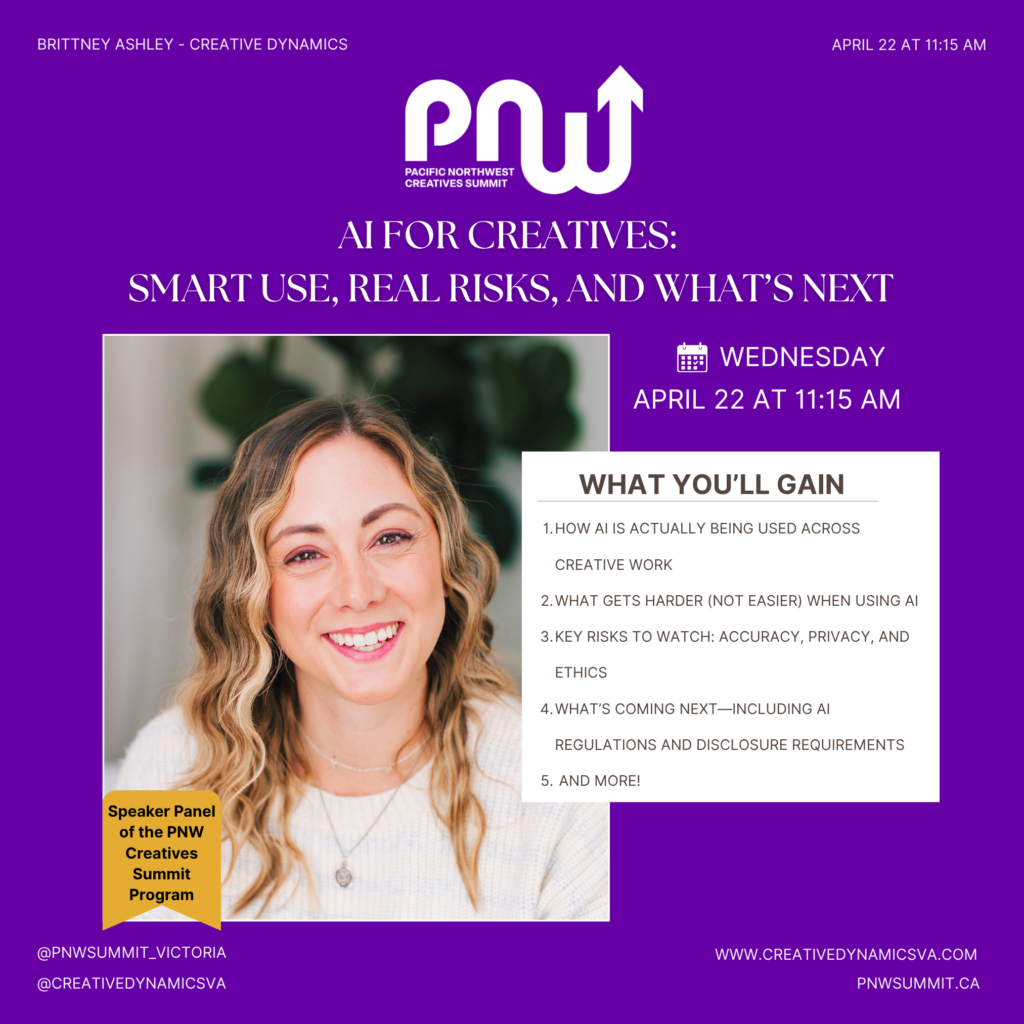
This is exactly why I’m so excited (and honestly, a little nervous — in a very human way) to be part of the PNW Creatives Summit session:
AI for Creatives: Smart Use, Real Risks, and What’s Next Wednesday, April 22, 2026 at 11:15 AM
If you want to see the full program, you can check it out here: https://pnwsummit.ca/the-program/
Who you’ll hear from (panel + moderator)
Here’s the lineup for this conversation — a mix of creative, leadership, marketing, compliance, and community perspectives:
- Sean Rodman (Moderator) — Executive Director at Story Studio and author of 9 young adult novels. Learn more at storystudio.ca.
- Casey Milone — Author/creative director and founder of Generative Marketing; Founder & CEO of Numonic (AI organization/compliance). More at caseymilone.com.
- Humaira Ahmed — Founder & CEO of BestHuman, supporting leaders and teams through executive coaching and leadership development, with a focus on integrating AI for better decision-making. https://besthuman.io/
- Brittney Ashley (She/Her) — Founder of Creative Dynamics Virtual Services; Métis mom of two; Certified Business Coach + Certified Imposter Syndrome Coach; host of Breaking Norms, Building Dreams. https://creativedynamicsva.com/
- Marleen Kiral — Founder of Almostronaut Creative, blending playful marketing with the details (especially the legal ones), working with a neurocomplex team.
- Radhika Graham (she/her) — Event planner focused on sustainable, inclusive, people-first experiences across Vancouver Island and the Gulf Islands. https://radoccasions.ca/about/
Why this conversation matters (especially for creatives)
AI isn’t just a productivity tool. It’s a shift in how work gets created, how ideas get shared, and how trust gets built.
And creatives are right in the middle of it.
- We’re being asked to create more, faster.
- We’re being told AI can “do it for us.”
- We’re watching industries change in real time.
So the question isn’t “Should I use AI?”
It’s: How do I use AI in a way that protects my voice, my values, and my people?
What I’ll be bringing to the panel
I’m coming into this conversation with two lenses:
- Human-first operations and marketing strategy (how we build sustainable businesses without burnout)
- Practical AI integration (without overcomplicating your business) – We build AI agents, but more importantly, we focus on where they actually fit. Not adding more tools for the sake of it, but integrating AI into existing systems to streamline workflows, support teams, and create real operational ease.
- Imposter syndrome + nervous-system-aware leadership (because tech adoption isn’t just technical — it’s emotional)
I’ve also been deep in learning lately with AI — including a Harvard AI course and it’s reinforced something I feel strongly about:
AI should support humans, not replace human responsibility.
Smart use: where AI actually helps
When AI is used well, it can be an incredible support tool — especially for:
- Brainstorming and outlining
- Turning messy thoughts into structure
- Drafting content you can refine
- Summarizing long notes or transcripts
- Supporting admin tasks that drain creative energy
But the “smart use” part only happens when you stay in the driver’s seat.
Real risks: what gets harder (not easier)
This is the part people skip and it’s the part we have to talk about.
1) Accuracy and hallucinations
AI can sound confident and still be wrong. That’s not a small issue, it’s a trust issue.
If you’re using AI for:
- client deliverables
- claims about results
- legal/financial/health-related info
…you need a verification process. Period.
2) Privacy and confidentiality
If you paste sensitive client info into the wrong tool, you can create risk you didn’t intend.
Human-first means asking:
- What data am I sharing?
- Where is it stored?
- Who owns it?
- What’s the worst-case scenario if it leaks?
3) Ethics, originality, and creative ownership
Creatives are rightfully asking:
- What was this model trained on?
- Who got credit (or didn’t)?
- Where’s the line between inspiration and extraction?
Even if you’re using AI for speed, you still want your work to feel like you.
What’s next: regulations + disclosure + trust
Whether you love AI or hate it, one thing is clear: disclosure expectations are rising.
Clients, audiences, and platforms are starting to care about:
- what was AI-assisted
- what was human-created
- what data was used
- whether consent was involved
I don’t think this is about fear.
I think it’s about trust and creatives are leaders in trust-building.
The mindset piece: imposter syndrome in the age of AI
Let’s name the quiet thing:
AI can trigger imposter syndrome fast.
Because suddenly the story becomes:
- “Everyone else is ahead of me.”
- “If I don’t use AI, I’ll fall behind.”
- “If I do use AI, I’m a fraud.”
That’s a brutal double bind.
Here’s what I want you to remember:
Using AI doesn’t make you less talented. Not using AI doesn’t make you irrelevant.
Your value isn’t your speed.
Your value is your judgment, your taste, your lived experience, your ethics, your empathy, your ability to see nuance and your ability to create something that actually lands with humans.
My bottom line: human-first, always
I’m a big believer in human-in-the-loop thinking:
- Humans set the intention
- Humans make the final call
- Humans stay accountable
- AI supports the process
That’s how we keep creativity alive and use technology wisely.
Come join the conversation
If you’re attending the PNW Creatives Summit, I’d love to see you at the session:
AI for Creatives: Smart Use, Real Risks, and What’s Next Wednesday, April 22, 2026 at 11:15 AM
Full program details here: https://pnwsummit.ca/the-program/
And if you’re not attending, I still want you in this conversation — because creatives deserve spaces where we can talk about AI with honesty, nuance, and care.
If you’re navigating AI adoption right now and feeling overwhelmed, you’re not behind.
You’re human.
Want support integrating AI into your business?
If you want to use AI in a way that’s ethical, human-first, and actually sustainable, I’d love to help.
- We can map where AI fits in your workflow (and where it doesn’t)
- Build a simple, repeatable process your team can maintain
- Reduce overwhelm while keeping your voice and values intact
Book a call and let’s talk about what would make AI feel supportive in your business.



Comments +